
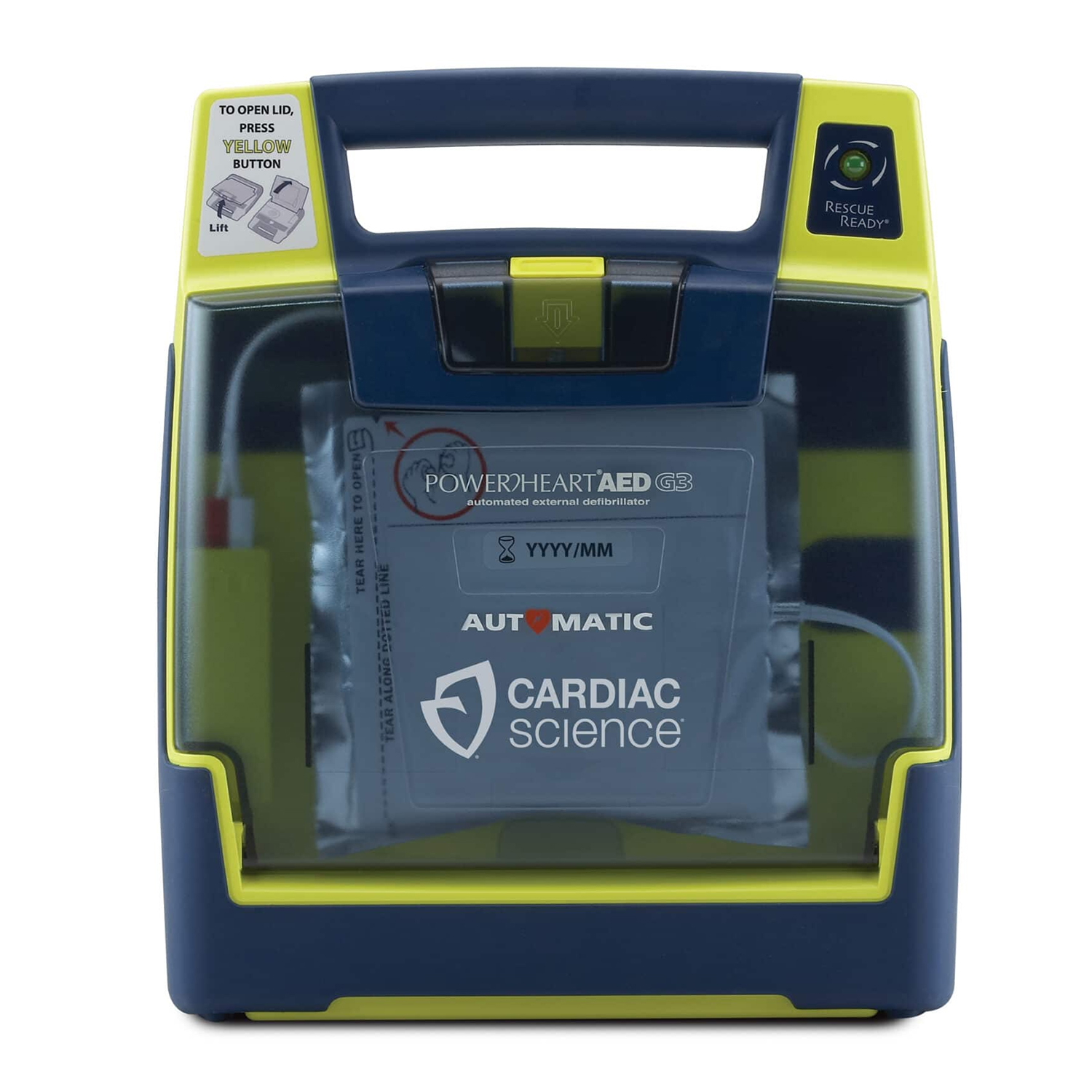
The Powerheart G3 AED Defibrillator is a self-testing, battery-operated automated external defibrillator (AED). After applying the AED’s defibrillation pads to the patient’s bare chest, the AED automatically analyzes the patient’s electrocardiogram (ECG) and either delivers a shock (automatic model) or advises the operator to press the button and deliver a shock if needed (semi-automatic model). The Powerheart G3 AED guides the operator through the rescue using a combination of audible alerts, voice prompts, and visible indicators.
How the Powerheart G3 Works
When a victim exhibits symptoms of sudden cardiac arrest (unresponsive and not breathing), rest assured when the Powerheart G3 is nearby. Quickly place the pads onto the victim and immediately monitor their heart rhythms. If the AED detects a shockable ventricular tachyarrhythmia, the device will automatically charge and advise the operator to deliver therapy (Semi-Automatic AED G3) or automatically deliver the charge (AED G3 Automatic). If the victim is breathing post-resuscitation, keep the AED attached to the victim to allow for the acquisition and detection of the ECG rhythm.
Features of the Powerheart G3 AED Defibrillator:
- Rescue Ready Technology – Every day, to ensure functionality at any moment, the Cardiac Science Powerheart AED G3 self-checks all main components (hardware, software, battery, and pads). Each week, the AED partially charges the high-voltage electronics. Each month, the AED charges the high-voltage electronics to total energy.
- RescueCoach™ Voice Prompts to Guide Rescuers – The Powerheart AED G3 analyzes the heart rhythm when the rescuer applies the pads and “knows” when to deliver (or not) the shock. In the automatic model, the AED delivers the shock with no button to push and no human intervention. In the semi-automatic model, a voice prompt notifies the rescuer when to shock with the press of a button. After the shock, the unit prompts CPR with a recording of a metronome that sets the pace for proper chest compressions.
- Status Indicators for the Powerheart G3 AED – If any part of the self-check fails, the Rescue Ready status indicator changes from green to red on the handle, and the device emits an audible alert until the user services the unit. A Powerheart G3 AED Defibrillator is Rescue Ready when a life depends on it.
- STAR® Biphasic Waveform – The STAR Biphasic Waveform measures the patient’s impedance and delivers a customized shock. This protocol allows the delivery of an optimized energy level to each patient. The energy levels for the Powerheart G3 AED Defibrillator are available in three different defibrillation shock levels.
- 9131 Defibrillation Electrodes – Cardiac Science 9131 Defibrillation Electrodes are single-use and intended to be used with Cardiac Science automatic external defibrillators (like the Powerheart G3 AED) to monitor and deliver defibrillation energy to the patient. The electrodes are intended for short-term use (<8 hours) and must be used before the expiration date listed on the packaging. The AED electrodes treat cardiac arrest emergencies for patients over eight years of age or greater than 55 lbs.
- Pediatric Pads Available – When a patient is a child or infant up to 55 lbs (25kg) or up to 8 years of age, use the Model 9730 Pediatric Attenuated Defibrillation Electrodes that are compatible with the Powerheart G3. Do not delay the therapy to determine the patient’s age or weight.
