
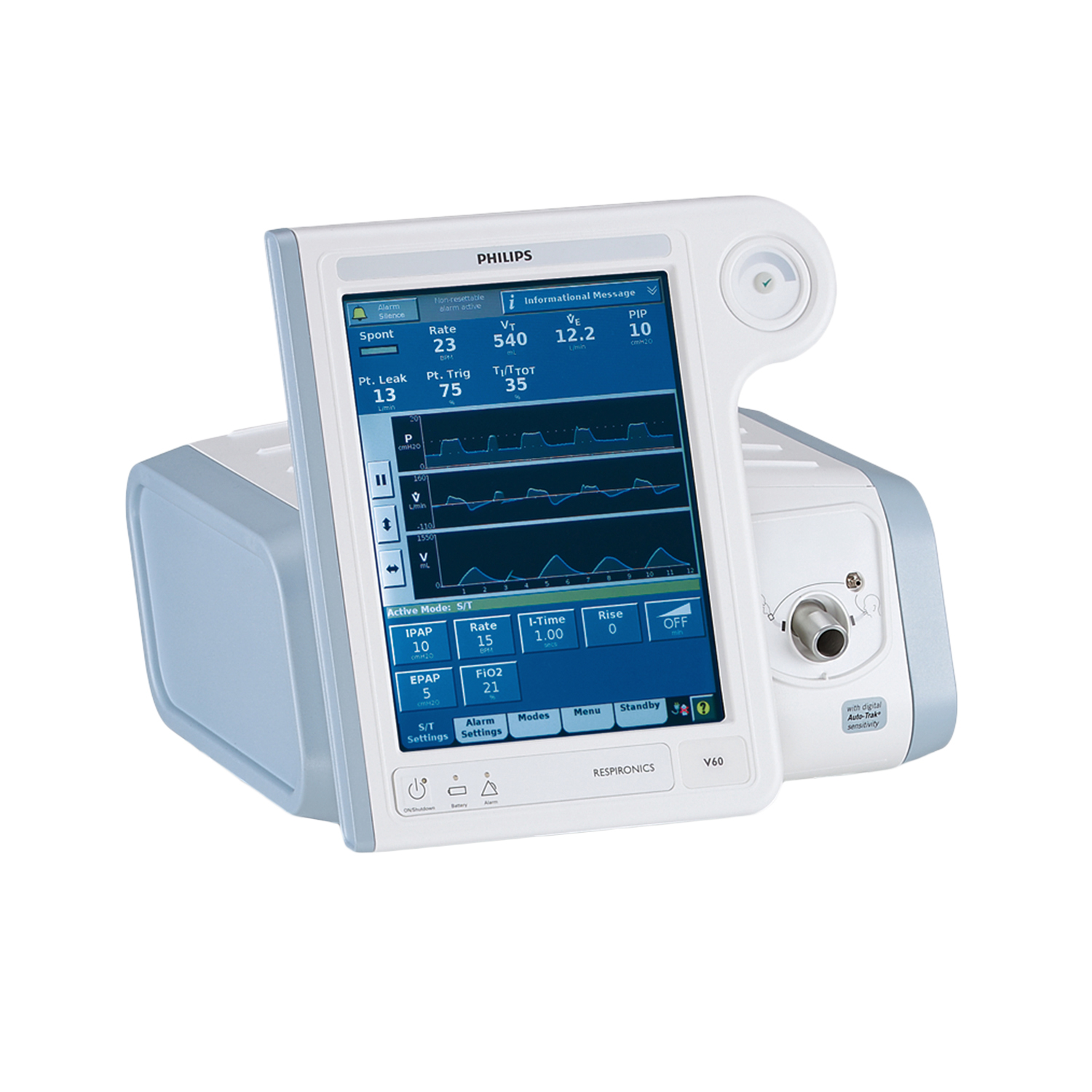
The Philips Respironics V60 Ventilator is an assist ventilator to augment patient breathing. It is intended for spontaneously breathing individuals who require mechanical ventilation. For example, patients with respiratory failure, chronic respiratory insufficiency, or obstructive sleep apnea in a hospital or other institutional setting under the direction of a physician. The Respironics Philips V60 is intended to support pediatric patients weighing 44 lbs (20 kgs) or greater adult patients.
The Philips V60 BiPAP Ventilator combines Respironics’ ventilation expertise with Philips’ focus on simplifying advanced health care. The result is the noninvasive ventilation gold standard with an invasive ventilation safety net and an interactive display that helps simplify patient management. Because every breath matters and every breath is different, patients need a ventilator that always follows their breathing pattern, whatever their understanding. The Philips Ventilator uses auto-adaptive technology to help ensure patient synchrony and therapy acceptance. The improved signal processing technology is finely tuned for both adult and pediatric patients. Another Ventilator by Philips is the Philips Respironics V60 Plus Philips Respironics V60 Plus.
- High-resolution graphics facilitate waveform interpretation.
- Internal 6-hour battery enables intra-hospital transport (actual battery time will vary depending on user settings and battery charge level). Standby mode supports patient-clinician interaction without nuisance alarms.
- Data communication capabilities support hospital connectivity.
- Respi-Link, a remote communication tool, allows efficient system diagnostics and upgrades via the Internet.
- AVAPS maintains a target tidal volume in a pressure-limited mode. It provides extra assurance similar to a volume-limited mode with the safety of a pressure-limited mode.
- CPAP with C-Flex offers three levels of flow-based expiratory pressure relief. This option improves sleep quality and patient comfort, adding greater flexibility and improving treatment acceptance.
- PCV can be used when greater control of the patient’s breathing pattern is required. Additionally, the option of ventilating a patient invasively gives the caregiver greater flexibility in the approach to treatment.
- ICU-grade NIV performance with enhanced safety and monitoring.
- Flexibility for intra-hospital transport with an internal 6-hour smart battery.
